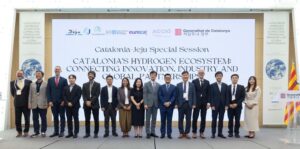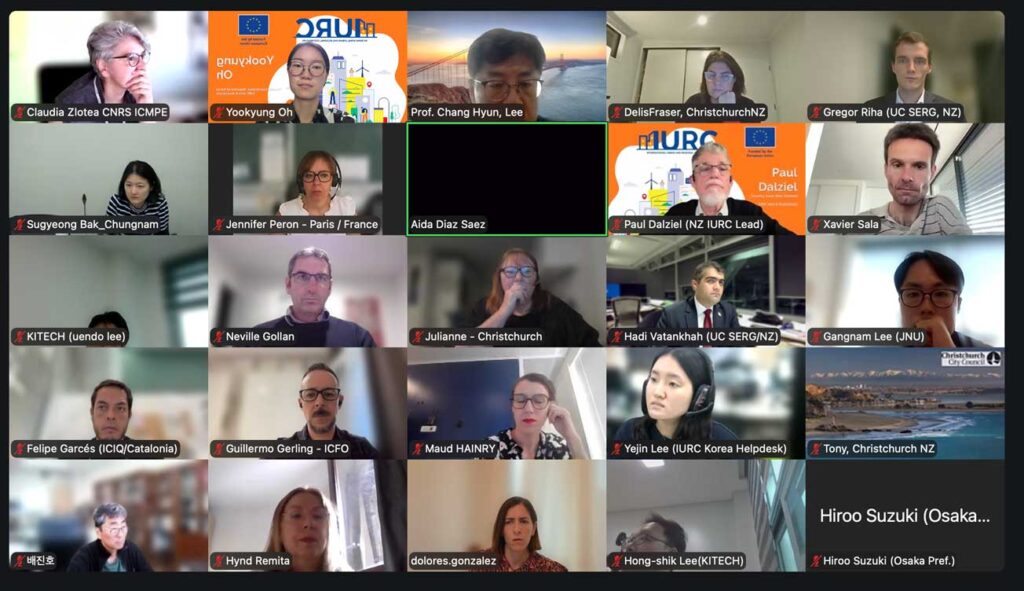
On 7 July, the Catalan Hydrogen and Circular Carbon Network (H2CAT) took part in an international technology workshop held under the EU’s IURC programme (International Urban and Regional Cooperation), focused on the hydrogen market and industry.
IURC is an EU initiative that fosters decentralised cooperation between cities and regions worldwide to accelerate innovation and sustainable urban development. The session brought together representatives from seven regions across three continents: Catalonia, Île-de-France (France), Christchurch and Taranaki (New Zealand), Chungcheongnam-do and Jeju-do (South Korea), and Osaka Prefecture (Japan).
During the session, Dolores González, promoter of the H2CAT Network, presented Catalonia’s hydrogen and circular carbon ecosystem, highlighting its growth since the network’s launch in 2023: over 80 research groups and a portfolio of more than 100 technologies in renewable hydrogen and circular carbon.
The workshop also featured researchers from the network presenting their technologies and research lines. Attila Husar (UPC) presented the UPC Hydrogen Research Center, which brings together research groups active across the entire hydrogen value chain. Xavier Sala (UAB) presented the SelOxCat group’s research on nanocatalysts and photoelectrodes for hydrogen production and CO2 reduction. Felipe Garcés (ICIQ) presented an ultra-scalable AEM electrolyser, a patented technology developed by Prof. Galán-Mascarós’s research group and currently in the scale-up phase. Finally, Guillermo Gerling (ICFO) shared the capabilities of Prof. García de Arquer’s research group in sustainable water electrolysis systems (PEM, alkaline and AEM), ranging from PFAS-free membranes and non-PGM anodes to precatalyst programming and self-driving labs.
This participation forms part of the network’s active collaboration with the Catalan Government’s Department of Research and Universities, and reinforces H2CAT’s commitment to opening its ecosystem to international cooperation, generating new opportunities for joint research, researcher exchange and access to European funding calls.